
Supporting high school students with STEM subjects
High school students are more adaptable than younger students and are ready to engage in more traditional learning forms in preparation for their various exams. In this case the focus is on providing as many examples and problem solving techniques as possible.
When time allows, we categorize problems into separate "families" of techniques, and help students learn to identify which question falls into which category. This works extremely well in Math for example.
Direct instruction is sometimes required for select chapters before intense tutorials can begin.
Are you falling for the "C-s get degrees" motto?
Students are asked to learn and then state solution strategies before diving in to solve, they provide these verbally. This habit ensures a true understanding and readiness of the subject.
One of the greatest problems that high school students have is a gap in their knowledge from previous years. This is the case for most students.
It is very difficult to cover all previous concepts if the student was not interested in STEM before and missed out on the basics. In math we most often see for example order of operations, handling negative numbers, misunderstanding fractions and concepts relating to equations.
Our team has developed a series of short quizzes (2-5 minutes long) the students can opt to answer before their tutoring sessions, which allows us to discover problem areas and design corrective measures to resolve the gaps. The student then watches an equally short presentation that explains the missed concept. We may give this as homework if the student is willing to do a bit extra at home. They take a related quiz again until they improve their score.
While initially this seems like a slow process, results are seen exponentially in a few weeks as students get a hang of the majority of the topics and do increasingly better.
Unfortunately, for many students working on high school classes, going back to early concepts is extremely demoralizing and can contribute to exam anxiety, bad grades and bad feelings about their learning.
We try an incremental approach that integrates old concepts into their current learning and is seen as a small preparation before the lesson and doesn't get the negative response that fully expanded lessons do.
Chemistry
An early foundation in chemistry provides the necessary building blocks for a student's future scientific education. It is the key to understanding biology, and is the bridge to physics, a precursor to quantum mechanics and more.
By investing in chemistry early, we are giving students the core vocabulary and conceptual map required to navigate the many sciences that depend on it.
Chemistry is a constant presence for students aiming to enter fields like medicine, bioengineering, and biomedical sciences.
To make learning chemistry more fun, students also learn how to use digital tools such as MolView to build molecules, visualize and better understand chemical bonding. This is a popular tool among university students studying chemistry and biology.
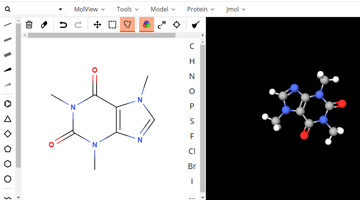
See for example the web pages constructed for the organic chemistry course at the University of Calgary here. The web page uses "JSMol" structures which can be built with MolView to depict molecules.
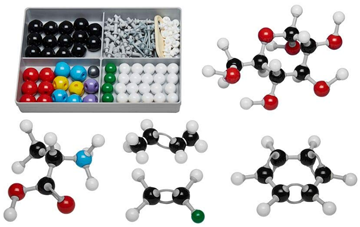
These are good alternates for the Molymod Kit when sessions are delivered remotely instead of in person.
Other digital tools for chemistry are functional group flash cards from the University of Illinois and digital interactive periodic tables.
Many of our students began familiarizing themselves with these tools and have ended up recognizing numerous molecules based on their 3D appearance.
