Tutor Calgary
Coding Lessons
Keeping children busy during the holiday months is not easy.
Call us today for some amazing boredom busters. Our team has created a proven fun lesson plan to teach Coding with MIT Scratch to elementary students.
We also provide Python and C# lessons for older students.

To make the coding fun we help students learn how to code
animations.
For example, we teach them what a parallax effect is,
to make animation projects more realistic.

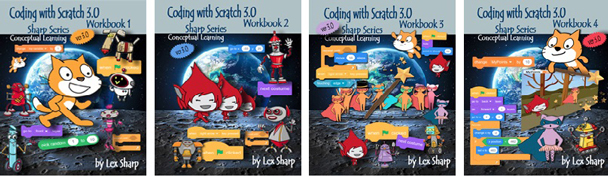
Each student gets 4 workbooks as part of this course which contains the lesson plans and provides a platform for further discussion.
This is an excellent platform for infusing math, geometry, art and sound into these projects. We get a chance to talk about perspective, graphic file formats useful to computer graphics, installing software, and much more. For students who have an affinity for gaming the course provides a chance to experience things from the other side and find out how games are programmed.

No more coding? Let's have a conversation about coding...
We had discussions with a few parents, and they were saying how coding is no longer relevant and students should not waste time on it, since everything is done with AI nowadays.
That is not quite true, there are many circumstances in which programmers collaborate with AI, but full projects are not always completed autonomously. Knowledge of programming is still necessary so that the person can understand what is going on in the code, and so that they can properly participate.
Our goal at Tutor Calgary is not that we should raise teens that compete with AI, but rather that they should understand important concepts in software engineering, database systems, theory of algorithms, time complexity and more. Students get introduced to a massive branch of this field which proves what computers cannot do by using Complexity Theory and the famous P vs. NP problem.
Coding lends itself to real life by turning problem-solving into a science. Algorithmic theory groups world problems into core archetypes and serves up universal strategies to solve them.
Many of these algorithms have applications not only on how AI learns, but also on how humans learn, and topics such as consciousness research. The relationship between consciousness and algorithms is one of the most fiercely debated frontiers in modern philosophy, neuroscience, and computer science. This debate hinges on the central question whether the human mind is a biological computer running highly sophisticated algorithms or is consciousness fundamentally non-algorithmic. We want our students to be able to participate coherently in such discussions, gain related employment and feel that they understand the modern world around them.
Students who have zero programming knowledge are left out and find it hard to fully understand the related science paradigms.
As a result of learning how to code, graduated students who continue into research can use this skill to process and analyze large data volumes that cannot realistically be fitted into traditional tools like excel sheets. This is instrumental in drawing conclusions from data collected during research projects.
Coding is also an immersive activity, requiring a depth of focus that naturally silences external distractions and locks the brain into problem-solving mode.
In a world run by algorithms, programming isn't a thing of the past, it is a most current literacy.
Classes
We provide one-on-one coding lessons for elementary, high school and
university students.
Our teachers are knowledgeable software engineers
with proven industry experience.


